
















Townhall.com, Where Your Opinion Counts
Talk Radio:   Bill Bennett   Mike Gallagher   Dennis Prager   Michael Medved   Hugh Hewitt   
TOP NEWS   LeftArrow - Townhall.com   RightArrow - Townhall.com  
Columns, funnies & more in your inbox!
Thursday, June 12, 2008
Terence Jeffrey :: Townhall.com Columnist
The Threat to the Car
by Terence Jeffrey
Vote on It:
Average Vote:
[+] Text [-]
 
Poll
What did you think of Gov. Sarah Palin's acceptance speech Wednesday night?


Recent evidence that automobile use is declining in America and that some Americans are making significant -- and in some cases not readily reversible -- changes in their lives because of escalating gas prices should be worrisome signs for those who love liberty.

No device is more in keeping with the American spirit than the automobile. Privately owned cars and trucks allow us to go where we want, when want. They are freedom machines.

Still, some liberals would like to use government to force Americans out of their cars.

They believe in socialized transportation, not free-market transportation.

In a free-market transportation system, a person purchases his own vehicle with his own money, buys his own gas with his own money and can drive his vehicle anywhere there is a road -- and, if he has the right kind of vehicle, some places where there are no roads.

Admittedly, the roads generally are constructed by government, albeit with funds extracted from the earnings and gasoline purchases of drivers.

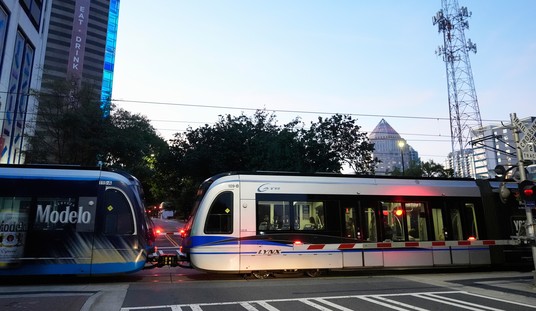
In a socialist transportation system, the government takes the taxpayers' money and purchases vehicles -- often buses or trains -- for itself or a government-funded agency. Where and when these vehicles go is determined by the government.

In a free-market transportation system, a person travels solely in the company of people with whom he has freely chosen to travel. In a socialist transportation system, a person may be compelled to travel in the company of people he does not know and who could even be a danger to him.

I have no doubt that most Americans who love the freedom of movement they derive from owning and operating a car or truck have recognized efforts by various levels of government to induce them to stop, or limit, their driving and cajole or compel them to leave the free-market transportation system and submit to the socialist transportation system.

Methods governments can use to do this include placing constraints on parking availability, forbidding taxpayers from using certain lanes of the highway (or even certain highways) unless they agree to carpool or ride a bus, and imposing excessive gas taxes or road tolls and using the excess revenue to subsidize money-losing public transit. Continued...

1 2
| Full Article & Comments | Next >
Share:
Vote on It:
Average Vote:
 
About The Author

Terence P. Jeffrey is the editor-in-chief of CNSNews

Be the first to read Terence Jeffrey's column. Sign up today and receive Townhall.com delivered each morning to your inbox.

©Creators Syndicate
Subject: my point
Chip, I see your point in your 5:11 post from yesterday.


My first - and certainly debatable - point is that I do think that a little extra production domestically would greatly help the price of oil to come down due to being on the steep part of the price curve on the supply/demand chart and all that.


I think the reason I react strongly to posts like that, though, is that they proceed from a premise that the government can and should control prices.

I'm thinking of statements like the following:

-"Extra US produced oil would have to be reserved mainly for US consumption"

-"if the US seperated it's oil from the global market"


Every time government attempts to control price, it just messes things up. This is true whether it tries to prop up prices (like with food) or hold them down (like with fuel in the late 1970s).

So even if the U.S. threw off the tyranny of wacko environmentalists and developed enough oil production to meet all our demand (which is entirely possible), I think we would create more problems than we fix by isolating ourselves from the global market.

Chris
You seem to disagree with me, but I don't see your point.

Whatever the global market is,
assuming enough additional US coastal sites were made open to drilling to exceed US demand , exactly why don't you think the price of gas would not
always stay close to the drilling costs if the US seperated it's oil from the global market?

Wouldn't duties/taxes on US oil sold abroad whenever domestic oil is too high, say, a lot more than a typical defense contractor's profit margin, above extraction costs.


Sign Up to Post Your CommentsSign Up to Post Your Comments
If you are already registered, click here to login. Otherwise, please take a few seconds to register with Townhall.com. Once you sign up, you’ll be able to post your comments immediately, use the action center, get podcasts, and more!
Note: Fields marked with a red asterisk (*) are required.
Salutation:
First Name:
*
Last Name:
*
Email:
*
Nickname:
*
Note: Nick name will be shown when you post comments.
Address 1:
*
Address 2:
City:
*
State:
*
Zip:
*
Phone:
      
Your daily dose of conservative columns, editorial cartoons, talk radio, news, and more!
(Bi-Weekly) We highlight the best opportunities from our partners for surveys, action items and more.