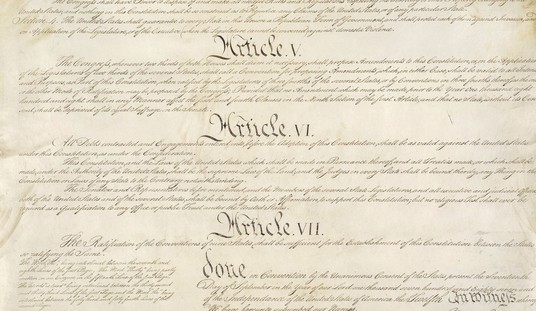






















Larry Sabato, director of the Center of Politics at the University of Virginia and a familiar cable TV pundit, has taken it upon himself to reform the U.S. Constitution -- to make it more in tune with a 21st-century political system. Among the eminently debatable ideas he puts forward in “A More Perfect Constitution: 23 Proposals to Revitalize Our Constitution and Make America a Fairer Country” are a single six-year term limit for presidents, two years of required national service for every citizen, and making it possible for foreign-born American citizens like Arnold Schwarzenegger to run for president. I talked to Professor Sabato by telephone on Thursday, Oct. 11, from his offices in Charlottesville, Va.
Q: What do you think is still sound about the Constitution?
A: There’s far more sound about it than needs repair. The superstructure is in good shape -- the separation of powers, the Bill of Rights and the essential underpinnings of American democracy are just as valid today as they were in 1787.
Q: What needs to be fixed and why?
A: I’ve got 23 separate proposals and they are pretty thorough and comprehensive, so I’m not going to summarize 23 ideas. But I’ll simply say we need some adjustments, some tweaking here and there in the powers of the branches, in the way that voters relate to the branches, and maybe particularly in adding a "politics article" to the Constitution.
The Founders were opposed to mass democracy and political parties. They later embraced both but it was too late for the Constitution. Look around the world: Most constitutions have a politics article helping to govern the politics of a country. It might help to do something about this insane primary system, for example, that we’re about to experience.
Q: In your recent L.A. Times commentary, the first change you talked about had to do with putting a brake on the president’s war-making powers. Can you elaborate?
A: Sure. The Founders would have been astounded that we have permitted the system to be hijacked by the executive. They wanted the president and Congress to share war-making powers. Look, this is in the nature of the executive. My proposal is a commentary on Harry Truman in Korea, Lyndon Johnson in Vietnam, Richard Nixon in Vietnam and George W. Bush in Iraq -- two Democrats, two Republicans. Excessive war-making authority is in the nature of the presidential beast.
So I suggest giving the president the leeway to go in and to have some months to try and make things work -- but then to force Congress to play a role every six months in giving a thumbs-up or thumbs-down on the foreign involvement. If the war does not have the support of the Congress and the American people, it’s probably not going to succeed in the long run anyway.
Q: Is it the Constitution’s fault that the executive has run amok on war-powers or is it the fault of a spineless Congress that is afraid to exert its own constitutional prerogatives?
A: I’m going to offer a third alternative: It’s simply that the Founders could not possibly have imagined a world in which the weapons and troops could be moved almost instantaneously. Our situation today could not be more different than in 1787, which is another justification for taking a look at the Constitution to see where we can build a better mousetrap.
Q: Some of your ideas could fall under the category of trying to “constitutionalize” the idea of fairness or more fairness. One of those ideas is to create a Senate with two more representatives added to the 10 most-populated states and one added to the next 15 largest. Why is this necessary?
A: I don’t want to make the Senate another House of Representatives. I do want to make the Senate a bit more representative of the larger population. In the beginning, the population differentials were not great from the largest to the smallest by comparison to today. California is 70 times the size of Wyoming, yet they both get two senators. When you add it all up, 17 percent of the people elect a majority of the United States Senate. That’s the tyranny of a small minority. That’s just as bad as the Founders’ concern about the tyranny of the majority overrunning minority rights. I’m opposed to both tyrannies.
Q: I thought the whole idea was to give every state in the Senate the same power as a way to counteract the House of Representatives and to balance or check the mob’s current passions?
A: The tyranny of the majority. Sure. That’s exactly right. But that’s why I think what I’ve proposed is a fair compromise. It’s the porridge being just right rather than being too hot or too cold. Giving a few additional senators to populate a state reduces the power of the smaller states but they still have greatly disproportionate power.
Q: Some of us -- I won’t name names -- love the idea of government gridlock and figure that the more gridlock, the better.
A: I wouldn’t disagree with that, in many cases. But you also want a system that can take action when action is needed. Sometimes our system is so gridlocked and so over-partisan and polarized that we can’t take action even when we need to.
Q: I was trying to think of something that the whole world can give thanks to because the Senate was so foot-dragging and road-blocking. Can you think of a good example of where the Senate prevented a bad idea from becoming law?
A: There are probably thousands (laughs). I don’t know that the whole world would be grateful, but you could think of various presidents’ desires for grand schemes abroad or at home that didn’t get through the Senate. I’m all for that. As I say, this is a matter of trying to do some tweaking, not fundamental changing, to get the porridge to be the right temperature -- not too hot, not too cold.
Q: We around here are fond of the Electoral College and … Continued... |