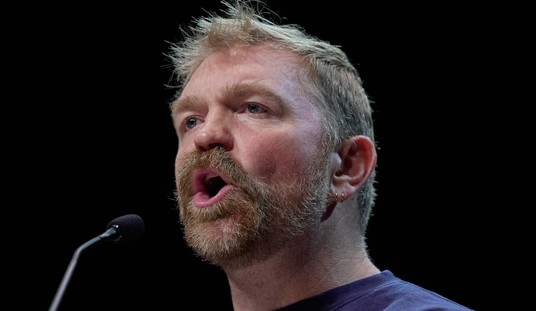
Pat Buchanan’s latest book, “Day of Reckoning: How Hubris, Ideology, and Greed Are Tearing America Apart,” paints a gloomy picture of America at home and abroad.
At home, Buchanan says, our political leaders can’t get it together to protect our southwestern borders from an invasion of illegal immigrants and because they nearly all idolize the ideology of “free trade” we can’t preserve our jobs and industries.
Meanwhile, overseas, our forces are stretched thin and the Bush administration, which he says has learned nothing from the fiasco of Iraq, is still worshipping at the altar of what Buchanan calls “democratism” – the idea that using military force to democratize the world is both good and doable. I talked to Buchanan Thursday while he was on his book tour in the Washington, D.C., area.
Q: Give us the 60-second synopsis of what “Day of Reckoning” is about?
A: What it is about is that are a series of crises heading down the road to the United States which are almost a perfect storm. They’re coming toward America at the same time. You’ve got an over-extended empire -- if you will, imperial overstretch -- where we’re committed to defend countries all over the world with an army the size it was in 1939. You’ve got two wars that appear to be without end. You’ve got a fiscal crisis with Social Security and Medicare really heading for the cliff. You’ve got a border crisis with 12-to-20 million illegals in the country who are not being assimilated.
Also, we’re in the middle of a cultural civil war, where one half of America and the other half disagree about the fundaments of right and wrong and morality and immorality, and we’re also balkanizing and breaking down into ethnic and racial and cultural enclaves, so that we’re ceasing to be one nation and one people.
All of these together are hitting at once, and I think it comes down to an existential crisis of the nation. Two big questions loom: Are we really going to be able to retain the Southwest if we don’t get control of our borders and stop this limitless invasion from the Third World and from Mexico into the southwestern United States? And secondly, are we going to be one nation and one people, the way we were at one time, if the Melting Pot is cracked and broken and we really cannot control mass immigration. That is a summary of what you’re saying and each chapter deals with it.
Another crisis that is looming is the dollar. Look, the euro used to be worth 83 cents; it’s worth $1.50. We’ve run up $5 trillion in trade deficits since NAFTA. We’ve lost 3 million manufacturing jobs under Bush. We are de-industrializing as China is industrializing. The point is that if you continue along this road, will the United States become dependent upon the entire world for the necessities of her national life for the first time, frankly, since almost colonial times?
Q: You’re generally considered an upbeat guy, but this sounds like crises upon crises upon crises.
A: I think it’s true. As you’re writing the book, you’re dealing with each of these individual problems, some of them very serious. You hear David Walker of the General Accounting Office talking about unfunded liabilities in the tens of trillions of dollars. There really seems to be on the part of government in both parties a lack of awareness of the gravity of the situation we are confronting. The book leads off with a single sentence which says “Pax Americana is dead.” The United States became the undisputed leader of the Western World in 1944-1945 and we led the West to victory in the Cold War. And in 1989 and 1991, when the Soviet Union and the Soviet Empire collapsed, we were the sole superpower, respected around the world and our leadership was wholly accepted. Now all that has all changed. We’re moving back to a multi-polar era, where the United States is still the first power on Earth, but it’s challenged by rivals. You’ve got Russia and China moving together. You’ve got Iran and Venezuela challenging the United States. You’ve got rampant hostility toward the president and our country all across the Middle East and the Islamic world. You’ve got alienation and estrangement from countries in Europe. So the uni-polar era is over. The question is, is the American Century over? Or can there be a second American Century?
At the end of the book I have a number of recommendations which I think if followed can certainly deal with four or five of these major crises. It’s very tough to find a solution to a culture war. Ronald Reagan couldn’t do it and some of the great presidents we’ve had can’t do it. I’m personally optimistic, but there is no doubt the country appears to have gone over the top and be heading down hill.
Q: You say ideology is a “false god” that’s leading us astray – and those ideologies are “free trade” and “democratism.”
A: Free trade was a policy that has hardened into an ideology. I used to be a free-trader myself, but if you take a look at the consequences you see all these jobs lost, these company towns turning into ghost towns, your manufacturing and productive capacity being exported more than your goods, your dollar sinking like a stone – and when your currency fails your country fails. It seems to me that the problem with the free traders is that they won’t say, “Wait a minute, is it working or is it not working?” We think the idea was good, but if the idea is failing us, then you change. My problem with the free-traders is they won’t even discuss any other policy than the one we are pursuing, which is clearly failing when we have got Bernanke and the treasury secretary going to Beijing, pleading with them to let their currency float. And we had a $233 billion trade deficit with China last year, the greatest trade deficit between any two countries in history. China’s booming. They’re growing at 12 percent – and we’re heading into a recession. I mean, if this is a successful trade policy, you ask, “What would a failure look like?”
Q: As for “democratism,” you’re talking about the Iraq war basically, aren’t you?
A: I’m talking about the Bush ideology – which he did not bring to Washington, but which he embraced and to which he converted sometime after 9/11 and before the “Axis of Evil” speech, where he decided that we are in a long war between good and evil and that the only salvation for the United States of America was to democratize the entire world, using American arms if necessary. Continued... |