| On Aug. 27, the Congressional Budget Office will release its
mid-session budget review. Undoubtedly, it will show severe deterioration in
the deficit since its January report. This will certainly lead to further
calls by Democrats to rescind last year's tax cut.
The CBO's most recent monthly budget report appeared on Aug. 9.
It showed that total federal receipts this fiscal year are running 10.1
percent below last year. Both individual and corporate income taxes are down
more than 17 percent, but Social Security taxes are up slightly.
With revenues down by $173 billion and spending up by $148
billion (October-July), the net result has been to turn last year's surplus
of $172 billion into a deficit of $150 billion -- a turnaround of $321
billion. For the full fiscal year, which ends on Sept. 30, the CBO expects a
deficit of $157 billion, up from $46 billion estimated in March.
The CBO will probably show larger spending and lower revenues
than estimated by the White House Office of Management and Budget a few
weeks ago. This will be trumpeted as proof that the Bush administration is
cooking the books. But the reality is that there is a substantial amount of
new economic data that has come available since the OMB report that would
also change its analysis substantially if redone today.
The most important new information came from the Commerce
Department on July 29, when it re-estimated economic growth for the last
several years. It shows sharply lower growth, a much deeper recession than
previously estimated and considerably lower corporate profits, among other
things. These data affect forecasts because they change estimates of the
relationship between total income and taxable income, and other technical
factors.
Furthermore, the CBO is constrained by congressional rules that
essentially require it to overestimate spending. In essence, it is required
to build into its baseline spending forecast all current spending. Thus if
Congress passes an appropriation for a one-time only purpose, the CBO will
still estimate that this money will be spent every year indefinitely. Thus
President Bush's recent veto of $5 billion worth of spending effectively
took $50 billion out of the spending baseline, which goes out 10 years.
There is little doubt that the falloff in revenues is the
principal cause of the budget's deterioration. Democrats will try to pin
this fact entirely on the 2001 tax cut. However, the CBO has already
explained that the vast bulk of lower revenues result from technical and
economic factors unrelated to the tax cut.
In an Aug. 13 paper -- "Where Did the Revenues Go?" -- the CBO
compares current revenues to projections made in January 2001, before any
tax cuts were enacted. Between then and now, revenues are $376 billion lower
than expected. But $302 billion of this, or 80 percent, results from
technical and economic factors that would have occurred even if the tax cut
had never been passed. Only $75 billion of the lower-than-expected revenues
result from legislated tax cuts.
In all likelihood, the CBO's new out-year budget projections
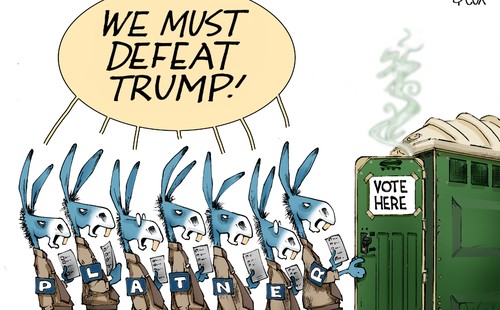
will show changes of similar magnitudes. But this will not stop Democrats
from demanding repeal of the tax cut, as if it is the sole and exclusive
cause of the deficit. Moreover, they will continue to imply that repeal of a
tax cut is not a tax increase.
Undoing the tax cut would cause individual taxes to be more than
$78 billion higher this year than under current law, $80 billion next year
and $95 billion the following year. I doubt that workers having a previous
pay increase taken away from them would fail to view this as a pay cut. But
this is the game Democrats are playing.
Despite my best efforts to get someone in Congress or the
administration to estimate the impact of rescinding the tax cut, I have been
unable to do so. The best I could do is look at last year's Joint Committee
on Taxation figures on the 2001 tax cut for this year and assume that
Democrats would take it away if they could. The effect would be to raise
taxes for those making less than $50,000 per year by $24 billion. Those with
incomes under $100,000 would bear 60 percent of the total tax increase.
Tax cuts didn't cause the surplus to disappear, and tax
increases won't bring it back. Moreover, it is hard to see what conceivable
economic benefit would result, given that mortgage interest rates are at
historical lows. Generally, budget deficits are thought to raise interest
rates. Yet mortgage rates are down almost a percentage point since March.
The real reason Democrats want to raise taxes by canceling the
tax cut is so they can spend the money to buy votes. To the extent that tax
cuts and deficits prevent them from doing so, that is a good thing.
|