| As Democrats ponder a period in which they are likely to be out
of power in Washington for some years, a few are looking to the Republicans
for ideas on how to rejuvenate their party. For their benefit, I will
explain how I think Republicans went from doormats to majority party.
First, I need to explain why Republicans became doormats in the
first place. From the Civil War until the Great Depression, they were the
majority party. During that long period, only two Democrats achieved the
presidency and during most of it Republicans controlled Congress, as well.
When Democrats seized control of Congress and the White House in
1932, Republicans did not necessarily see themselves moving into
semi-permanent decline. They retook the House and Senate in 1946 and had
every reason to think that they were moving back to parity with the
Democrats. When they got the White House as well as Congress in 1952,
Republicans thought they had returned to majority status.
But this proved not to be the case, as Republicans lost control
of Congress after the 1954 election. It would be another 26 years before
they took back either house of Congress, and 40 years before they gained
control of both houses.
The key reason for this long period in the wilderness is that
Dwight Eisenhower fundamentally shifted Republican economic policy away from
tax cuts and made balancing the budget its central plank. Gone was the
tax-cutting that defined the Republican Party in the 1920s. Eisenhower
squashed every congressional effort to cut taxes, saying that balancing the
budget had to come first.
As a consequence, the high World War II tax rates were kept in
place all through the Eisenhower years. It was not until Democrat John F.
Kennedy came along that Americans finally got tax relief.
Unfortunately, the Democrats quickly threw away their advantage
on the tax issue. But Republicans were now deeply wedded to Eisenhower-style
"fiscal responsibility" and did not reclaim it as their own. Indeed, most
Republicans voted against the Kennedy tax cut.
Voters continued to give the White House to Republican
presidents most of the time, in order to keep a check on Democratic
excesses. But they were unwilling to give Republicans anything close to a
majority in either the House or Senate. Voters did not see any reason to do
so because Republicans had no positive agenda -- there was nothing, really,
that they needed a majority in Congress to accomplish. Since their only job
was clean up Democrat messes and keep their excesses in check, all
Republicans needed was the presidency.
In 1976, however, Republicans were forced to rethink their
approach. Not only did they lose the White House, but their numbers in
Congress got so low that they were in danger of extinction. In the 95th
Congress, there were just 143 Republicans in the House and 38 in the Senate.
At this point, Jack Kemp revived tax-cutting as Republican
economic policy. But he did so against heavy resistance from many old-line
Republicans, who opposed tax cuts unless government spending was cut
equally. After all, it would be fiscally irresponsible to do otherwise.
However, most Republicans figured that they had nothing to lose by
supporting tax cuts without spending cuts. In 1977, it was the only life
raft around.
By 1978, with the passage of Proposition 13 in California, it
was clear that tax cuts were very popular politically. This led to big
Republican gains in Congress that year. With Ronald Reagan running on a tax
cut in 1980, he was able to give Republicans control of the Senate for the
first time in a generation.
Unfortunately, George H.W. Bush was a throwback to the
Eisenhower era, who foolishly thought that raising taxes was the responsible
thing to do. He was rightly punished by voters as a consequence. Instead,
they supported Democrat Bill Clinton, who promised a middle-class tax cut.
Fortunately for Republicans, Clinton immediately abandoned his
tax cut and instead pushed a tax increase. This led to the Republican
takeover of Congress in 1994 on tax cuts, which they delivered in 1997.
George W. Bush wisely ran on a tax cut in 2000 and got it enacted the
following year. Having kept their promise on the key issue of tax-cutting,
voters rewarded Republicans in this year's elections.
Now Democrats are complaining that Republicans are not acting
like they used to. Bill Moyers whines that the "reasonable" Republicans of
the Eisenhower era are now gone. Clinton economist Brad Delong laments that
Republicans no longer clean up Democrat excesses, and cut taxes instead of
running up budget surpluses for Democrats to later spend.
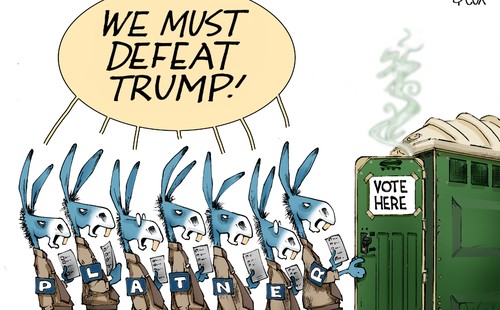
Democrats now have become Eisenhower Republicans -- opposing tax
cuts and demanding fiscal responsibility. Dubbed "Rubinomics" by some, after
Clinton Treasury Secretary Bob Rubin, I hope it's as successful for them as
it was for Republicans.
|