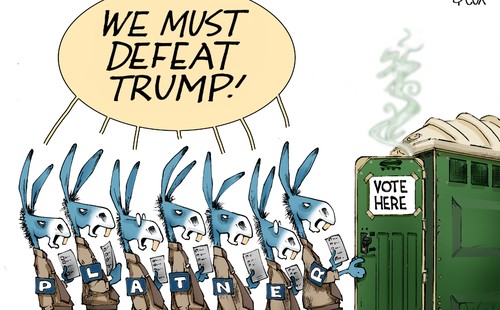
As Republicans fall in line, some reluctantly, behind the McCain candidacy, it isn’t the first time passionate GOP partisans have had to decide whether or not to settle or sit one out. Conservatives in the GOP might do well to take a look at history and ask what previous party standard bearers would do if they were around today.
Richard M. Nixon’s career was mixture of the high mountains and deep valleys he spoke about during his East Room farewell in August of 1974. But, there is no doubt that he was a powerful force in American politics for nearly a quarter of a century during a time of internal change and external challenge for America.
Whatever ultimate judgments people from across the political spectrum might have about Mr. Nixon, no one can dispute that he knew a thing or two about elections and political campaigns. He was on a national ticket five times (1952, 1956, 1960, 1968, and 1972) and successful four of those times. No one on the American political scene today approaches that record. Only Franklin D. Roosevelt matched it.
In my opinion, some of Richard Nixon’s most impressive achievements were in the way he handled things when he was out of power. He had a particular knack for dealing with adversity that served him well - seeing as he also had a tendency to invite conflict into his life and career. That the ability to navigate the deep waters of wilderness, rejection, and even exile, was intrinsic to his self-image is indicated by his best-selling book written in1962. That autobiographical work was entitled simply: “Six Crises.”
It is, however, from another moment in his career – one well after he wrote about six of his earlier political battles – that we find an example of party fidelity and political wisdom that speaks powerfully to current dynamics in the Republican Party.
This moment is not from 1960 or 1968, but rather from the year when the wheels fell off for Republicans – 1964.
Largely remembered as the year of the electoral massacre of Barry Goldwater by Lyndon Johnson, there is an interesting subplot to the story, one directed and dominated by the man who would four years later be elected as the 37th President of the United States.
Shortly after Richard Nixon’s rambling and anger-driven “last press conference” on the night of his defeat in the 1962 California gubernatorial race – when he uttered the infamous phrase “you won’t have Nixon to kick around anymore” – ABC News aired a program with the catchy title “The Political Obituary of Richard Nixon.” This brazen broadcast was hosted by Howard K. Smith and included, among guests driving nails into the former Vice President’s political coffin, an old Nixon nemesis – Alger Hiss. His was a convicted perjurer and was thought by many to have been a Soviet spy (an allegation proven to be true after the end of the Cold War). The uproarious response to this television program led to the eventual cancellation of Smith’s new show, and revealed significant and enduring latent sympathy for Nixon on the part of many Americans.
Nixon, however, seemed resigned to the fact that his electoral life was most likely over. He moved his family from California to New York, and immersed himself in what would become a very successful law practice. He would speak out on issues from time to time, but it wasn’t likely that he’d run for office again – at least that was the conventional wisdom. Nixon was poised to be an ironically young (at 50 years of age) elder party statesman.
Meanwhile, Barry Goldwater was well on his way to capturing the 1964 GOP nomination. He had supported the more moderate Nixon in 1960 while telling conservative Republicans that it was time for them to “grow up” – challenging them to become better organized. And grow up they did.
In the immediate wake of the Kennedy assassination in November of 1963 there was some initial speculation that the 1964 election might favor another Nixon candidacy, but the former Vice President observed how quickly and effectively President Johnson positioned himself in his new office, and correctly saw him as virtually unbeatable. It’s true that he had some difficulty totally putting the idea of a run against Johnson out of his mind. He flirted here and there with it – but ultimately resigned himself to the inevitability of Goldwater.
And this is where Richard Nixon demonstrated his political savvy and skill in a way that should be remembered by Republicans in 2008.
It was clear that the two other big Republican guns in 1964, Governors Nelson Rockefeller of New York and George Romney of Michigan, had little interest in supporting Barry Goldwater. Nixon, however, knew that anyone who really wanted to have a serious future shot at a presidential nomination could not afford to be a bystander, no matter how bad the results November might turn out to be.
Continued... |