








As President Bush continues to receive criticism about his recent remarks in a speech to the Knesset in Jerusalem, many are taking a fresh look at the personalities and politics of previous generations.
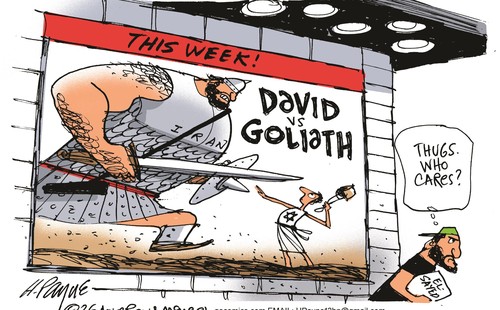
Mr. Bush, speaking on a visit to mark the 60th anniversary of the creation of the modern state of Israel, told the Israeli parliament that, “some seem to believe we should negotiate with the terrorists and radicals, as if some ingenious argument will persuade them they have been wrong all along. We have heard this foolish delusion before.” Then he evoked images of Nazi tanks cascading into Poland in 1939 decrying “the false comfort of appeasement has been increasingly discredited by history.”
Would-be Democratic nominee, Barack Obama, has continually reiterated his views on meeting with the bad guys. He insists that what he wants to do is very much in the spirit of his hero and the man he wants to be when he grows up - John F. Kennedy. In his January 20, 1961 inaugural address JFK said: “Let us never negotiate out of fear. But let us never fear to negotiate.”
But as Nathan Thrall and Jesse James Wilkins pointed out in their recent op-ed piece appearing in the New York Times, when Kennedy tried to put this into practice very early in his administration, it only served to convince his Soviet counterpart, Chairman Nikita Krushchev, that the youthful and “charismatic” U.S. president was a diplomatic light-weight.
There is a great argument to be made that the 1960s would not have been as tense as they were if the June 1961 summit meeting had never taken place. The Berlin Wall challenge a couple of months later and Cuban Missile Crisis in October of 1962 seemed to flow from how Nikita sized-up Jack in Vienna.
Barack Obama apparently has little understanding of history – particularly the issues that confronted JFK’s generation (“tempered by war”). Or maybe it’s just that he’s not interested in letting the past, with its clear patterns, inform the present – or future.
Eleven minutes after David Ben Gurion announced the birth of the modern State of Israel, President Harry S. Truman signed a document officially recognizing the new nation. The single typewritten page, on display these days at the Truman Presidential Library in Independence, Missouri, shows the President’s cursive corrections - including a wording change from “new Jewish state” to “State of Israel” - and the directive “Approved May 14, 1948.”
This was a bold step for the American president, one opposed by powerful members of his own administration. His Secretary of State, George C. Marshall, was so strongly opposed to this that he told his boss that he might not vote for him that November.
But Harry Truman was a savvy politician with an autodidactic appreciation for history – ancient and recent. As a boy, when his chronic near-sightedness kept him from some strenuous activities, he would lose himself in books. According to historian Michael Beschloss, among his favorites was a “gold-trimmed, four-volume history called Great Men and Famous Women.” One of the men chronicled was Cyrus the Great, King of Persia, who “enabled the Jewish people to leave their exile and go back to Palestine.” It’s possible that this ancient story may have been on Truman’s mind as he dealt with the Jewish-Palestine issue. More recent history, particularly the events of the late 1930s, may have also influenced his presidential decisions.
Appeasement was never really a “bad” word until it became forever identified with the foreign policy failures in Great Britain under the premiership of Neville Chamberlain. The word itself simply means to pacify or soothe. Most of us understand that there is a measure of this required for peaceful and civilized living and discourse.
But when appeasement met Adolf Hitler, it was manipulated, twisted, scorned, and ultimately dismissed. To put it in the words of Sean Connery playing a character in the 1987 movie The Untouchables, Mr. Chamberlain had brought a knife to a gunfight in Munich.
To make matters worse, his knife was crafted out of a very thin sheet of paper.
Harry Truman was a senator from Missouri when all this was going on and he watched in horror as Great Britain seemed to be officially determined to feed Europe to the Nazi alligator one bite at a time. He also knew and noted that the policy of appeasement was not just in play over the fate of Czechoslovakia, but it also had another deadly and dreadful application – one that would impact the Jewish people.
The British government released a White Paper on the issue of Palestine in May of 1939. Since the 1917 Balfour Declaration and during the period British Mandate they had been largely supportive of Jewish migration to Palestine and the idea of a Jewish state there. In essence, the new policy statement changed all of that. It advocated severe limitations on Jewish immigration to Palestine; this at a time when European anti-Semitism was reaching critical mass.
Continued... |