




















Townhall.com, Where Your Opinion Counts
Talk Radio:   Bill Bennett   Mike Gallagher   Dennis Prager   Michael Medved   Hugh Hewitt   
TOP NEWS   LeftArrow - Townhall.com   RightArrow - Townhall.com  
Columns, funnies & more in your inbox!
Friday, May 16, 2008
Donald Lambro :: Townhall.com Columnist
Primary Turnout Claims Turn Out To Be Half-Baked
by Donald Lambro
Vote on It:
Average Vote:
[+] Text [-]
 
Poll
Who should John McCain pick as his running mate?


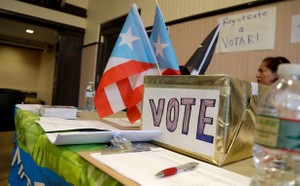
WASHINGTON -- Democrats are claiming that high voter turnout in their primaries is proof positive that they'll win the White House in November.

It is a familiar claim, made by one party or the other, that pops up every four years, but it contains not a morsel of truth. Many studies show no correlation between party primary participation and general election results.

Nevertheless, in a memorandum to its supporters and the news media, the Democratic National Committee is crowing, "(R)ecord turnout during the primaries has been transformational for the Democratic Party as record numbers of new voters are being registered."

In this equation, new primary voters equal more general election votes. "Democrats are energized all across the country and ... if Democrats show up and talk about our values, we will win," the memo asserts.

No one knows more about turnout than Curt Gans, the veteran voter analyst who heads the Committee for the Study of the American Electorate at American University. So when I asked him if the Democrats' claims had merit, he explained that it is wrong to conclude that a party's higher primary turnout will result in victory at the ballot box in the election.

"It is true that turnout has been extraordinary this primary season, particularly in the Democratic party, but also in the Republican party," Gans told me. As of last week, "24 states that have had primaries have had record turnout, 22 Democratic primaries have set records and 12 Republican primaries have set records."

"But there is not necessarily a correlation between primary turnout and general election turnout," he continued. "There is no rule on this. You can have high turnout in the primaries and still lose."

Look what happened to the Democrats when George McGovern won the nomination in 1972 on a wave of anti-war fervor that produced record primary turnout in his party. The South Dakota senator was crushed in an electoral landslide by President Nixon, and carried only one state. Republican analysts who are closely studying this year's voter turnout statistics point to similar cases in which the party with the highest primary turnout has been trounced in the election.

In 1988, for instance, after eight years of Ronald Reagan's presidency, frustrated Democrats flocked to the primaries, with a turnout rate that was twice that of Republicans. But Vice President George H. W. Bush easily defeated Gov. Michael Dukakis.

It seems that years in the political wilderness tend to produce higher turnout rates. "Since 1972, the out-of-power party has had higher turnout in the primaries in every election except for 1980," according to a recent GOP analysis of primary history. In 1980, though, the Republicans didn't need a high primary turnout to help them. Ronald Reagan was their candidate and Jimmy Carter's failed presidency was as dead as a doornail before the election had begun. Continued...

1 2
| Full Article & Comments | Next >
Share:
Vote on It:
Average Vote:
 
About The Author

Donald Lambro is chief political correspondent for The Washington Times.

Be the first to read Donald Lambro's column. Sign up today and receive Townhall.com delivered each morning to your inbox.

Subject: Eon
These first time voters,are young people who don't want to be "Drafted".In fact this election may prove to be the most unpredictable of all.The war in Viet-Nam brought people to the polls,because it was a no win situation.This general election will have a "Fine Point" to it.The more people to vote, makes our country healthy."US" can't complain about that...

No real correlation
can be made on either side, simply because of the fundamental difference between primaries and general elections.

In primaries, the "party faithful" turn out on both sides, determined to see that "their guy" (or in the Hillary-huggers' case, "girl") gets nominated. This is done to drive their party in a specific direction, as per Reagan's observation in 1980 that you can always spot a Democratic motorcade because it only turns left. This is why both parties have become increasingly partisan. Which I regard as a good thing- it's preferable to having "choices" that are to all intents and purposes indistinguishable from each other- which is how the Republicans lost control of Congress in 2006.

But when you get to the general election, it's a different story. There, anyone with an interest, on any side, may be motivated to show up at the polling place, which means the results are far less predictable. As much as anything else, the Democratic loss of Congress in 1994 can be attributed to the fact that their diving turn to the left under the Clintons "energized" (or more exactly, "p***ed off") a lot of people who didn't normally bother to vote. That year, there was no noticeable "bulge" in primary turnout; the "faithful" on both sides showed up then- and everyone else showed up in November.

Oh, and here's a fun trivia fact; the election that statistically showed the biggest "bulge" in primary voting for the GOP was in 1992, when George H. W. Bush was running for re-election. In case no one's noticed, he lost. (Information Please Almanac, 2000 edition.)

Primary turnouts have as much to do with general election results as numbers of mortgages loaned have to do with numbers actually paid off on time. That is, not much.

cheers

eon
Sign Up to Post Your CommentsSign Up to Post Your Comments
If you are already registered, click here to login. Otherwise, please take a few seconds to register with Townhall.com. Once you sign up, you’ll be able to post your comments immediately, use the action center, get podcasts, and more!
Note: Fields marked with a red asterisk (*) are required.
Salutation:
First Name:
*
Last Name:
*
Email:
*
Nickname:
*
Note: Nick name will be shown when you post comments.
Address 1:
*
Address 2:
City:
*
State: