Townhall.com, Where Your Opinion Counts
Talk Radio:   Bill Bennett   Mike Gallagher   Dennis Prager   Michael Medved   Hugh Hewitt   
BREAKING NEWS  LeftArrow - Townhall.com   RightArrow - Townhall.com  
Columns, funnies & more in your inbox!
Sunday, October 24, 2004
George Will :: Townhall.com Columnist
How Voter Fraud Threatens Our Democracy
by George Will
Vote on It:
Average Vote:
[+] Text [-]
 
 
Poll
Who won Tuesday's presidential debate?


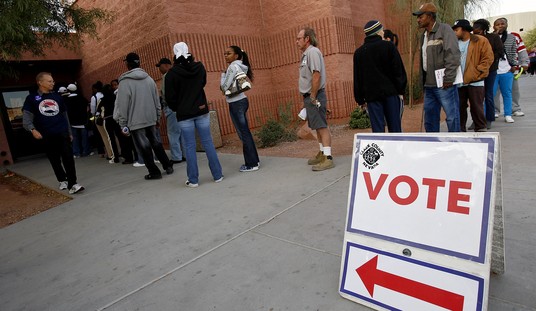
   WASHINGTON -- Not since the election of 1800, the first in which one party displaced another from the presidency, has there been such anxiety about voting. In 1800 there were fears that the losing side would resort to arms. Today's worry concerns a cloud of locust-like lawyers asserting novel theories that purport to demonstrate that sensible rules, such as requiring voters to have identification, are illegal, even unconstitutional.

     This locust litigation will erupt around any close election -- any not won beyond ``the margin of litigation.'' The lawyering, which has already begun, will attack rules designed to defeat a banal and familiar phenomenon -- old-fashioned fraud. Concerning which, there is a timely and disturbing new book, ``Stealing Elections: How Voter Fraud Threatens Our Democracy'' by John Fund of The Wall Street Journal.

     Even though the 1992 election saw the largest percentage increase in voter turnout since 1952, Bill Clinton quickly sought to address the supposed ``crisis'' of nonparticipation with the National Voter Registration Act -- aka ``Motor Voter.'' It, Fund says, imposed ``fraud-friendly'' rules on the states, requiring them, for example, to register to vote anyone receiving a driver's license, and to offer mail-in registration with no identification required.

     Given such measures, perhaps we should not be surprised that, as Fund reports, since 1995, Philadelphia's population has declined 13 percent but registered voters have increased 24 percent. Are we sure we should we be pleased?

     The unexamined belief that an ever-higher rate of voter registration is a Good Thing has met its limit in the center of the state that this year is the center of the political universe -- Ohio. The U.S. Census Bureau's 2003 estimate is that in Franklin County -- Columbus -- there are approximately 815,000 people 18 or over. But 845,720 are now registered.

     One reason for such unacceptable numbers in various jurisdictions across the nation is that voter rolls are not frequently enough purged of voters whose status has changed. For example, in 2000 The Indianapolis Star's Bill Theobald reported that ``hundreds of thousands of names, as many as one in five statewide'' were improperly on Indiana registration rolls ``because the people behind those names have moved, died or gone to prison.'' Unfortunately, there is reluctance, especially among Republicans, to support measures that might appear to have a ``disparate impact'' on minorities and therefore be denounced as racist.

     Today Americans demand, as a California voting official says, the kind of convenience in voting they enjoy in buying airline tickets. So election ``day'' can be three months long (in Maine). Absentee voting has come to be considered a right -- yet another one -- of convenience rather than a limited privilege understood as a concession to necessity. Soon, voting by mail (Oregonians all vote this way) and even online will be regarded as rights.

     These measures are supposed to increase turnout. However, according to Curtis Gans of the Committee for the Study of the American Electorate, all research is ``unequivocal in showing that easy absentee voting decreases voter turnout'' because ``you are diffusing the mobilizing focus away from a single day.''

     What liberalized registration and voting procedures do increase are opportunities for fraud, including the sort that Milwaukee television station WTMJ found in 2002. Fund says it ``filmed Democratic campaign workers handing out food and small sums of money to residents of a home for the mentally ill in Kenosha, after which the patients were shepherded into a separate room and given absentee ballots.''

     In 2000, in heavily Democratic St. Louis, at 6:30 p.m., a judge, responding to a Democratic complaint filed in the name of a man the judge did not actually hear from (the man was dead), ordered polls to remain open until 10 p.m., three hours longer than the law allows, and ordered one voting place downtown to be open until midnight.

     Before 7 p.m., all over the city, persons were receiving automated, prerecorded phone messages from Jesse Jackson saying, ``Tonight the polls in St. Louis are staying open late until 10 p.m. in your neighborhood and until midnight downtown.'' Between 7 and 7:30 p.m., Al Gore was calling radio stations to announce the later voting hours. Apparently the entire episode was orchestrated by the Democrats well in advance.

     Fund's book is replete with stories enraging about the past and ominous about the integrity of American democracy for the foreseeable future, which arrives in less than two weeks.

Share:
Vote on It:
Average Vote:
 
About The Author
George F. Will is a 1976 Pulitzer Prize winner whose columns are syndicated in more than 400 magazines and newspapers worldwide.
 
TOWNHALL DAILY: Be the first to read George Will's column. Sign up today and receive Townhall.com daily lineup delivered each morning to your inbox.
Sign Up to Post Your CommentsSign Up to Post Your Comments
If you are already registered, click here to login. Otherwise, please take a few seconds to register with Townhall.com. Once you sign up, you’ll be able to post your comments immediately, use the action center, get podcasts, and more!
Note: Fields marked with a red asterisk (*) are required.
Salutation:
First Name:
*
Last Name:
*
Email:
*
Nickname:
*
Note: Nick name will be shown when you post comments.
Address 1:
*
Address 2:
City:
*
State:
*
Zip:
*
Phone:
      
Your daily dose of conservative columns, editorial cartoons, talk radio, news, and more!
(Bi-Weekly) We highlight the best opportunities from our partners for surveys, action items and more.