















Have you heard the news? Belief is bad.
Pick up an eggheady book review, an essay in Time magazine or listen to a
thumb-suck session on National Public Radio for very long and you'll soon
hear someone explain that real conviction - dogmatism! - is dangerous.
Andrew Sullivan, in his new book "The Conservative Soul," declares a jihad
on certainty, by which he means the certainty of fundamentalist
"Christianists" - the allusion to Islamists is deliberate. The New
Republic's Jonathan Chait proclaims that liberalism is the anti-dogmatic
ideology. Sam Harris, a leading proselytizer for atheism, has declared a
one-man crusade on religious certainty. Intellectual historian J.P. Diggins
writes in the latest issue of The American Interest that there's a war afoot
for "the soul of the American Republic" between the forces of skepticism and
infallibility. And so on.
Much of this stems from the popularity of Bush hatred these days. Bush's
alleged "messianic certainty" - to use Sen. Barack Obama's words - is
dangerous and evil in the eyes of supposedly meek and nuanced liberals.
The rot, not surprisingly, has reached Hollywood. For example, in "Star
Wars: Episode III - Revenge of the Sith," George Lucas caved to the
fashionable anti-absolutism that comes with Bush hatred by having a young
Obi-Wan Kenobi proclaim, "Only a Sith lord deals in absolutes!" Translation:
Only evil people see the world as black-and-white. This signaled that
Lucas's descent into hackery was complete, since it was Lucas himself who
originally explained that the entire universe is divided into light and dark
sides.
Longtime New York Times columnist Anthony Lewis captured the thought nicely
a few years ago when he said that a primary lesson of his entire career was
that "certainty is the enemy of decency and humanity in people who are sure
they are right, like Osama bin Laden and John Ashcroft."
Whenever I hear people say such things, I like to ask them, "Are you sure
about that?" When they say yes, which they always do, I follow up by asking,
"No, no: Are you really, really certain that certainty is bad?" At some
point even the irony-deficient get the joke.
But they still don't understand that the joke is on them. Virtually every
hero in human history has been driven by certainty, by the courage of their
convictions. Sir Thomas More and Socrates chose certain death, pun intended,
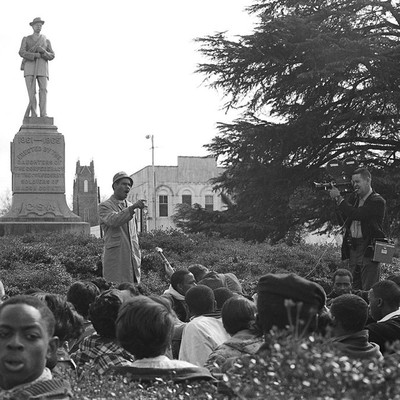
over uncertain life. Martin Luther King Jr. - to pick liberalism's most
iconic hero - was hardly plagued with doubt about the rightness of his
cause. A Rosa Parks charged with today's reigning moral imperative not to be
too sure of herself might not have sat at the front of the bus. An FDR
certain that certainty is the enemy of decency and humanity might have
declined to declare total war on Nazism for fear of becoming as bad as his
enemy.
The fact is that unless you know where you stand, it's unlikely you'll have
the courage to understand where someone else is coming from.
Obviously, there's more than a grain of truth to the view that
closed-mindedness is bad. Immunity to new facts and a smug confidence that
you couldn't possibly be wrong are serious character flaws and the source of
grave mistakes. Yes, of course, dogmatism can be very bad, if the dogma in
question is bad. But, as Chesterton teaches, a dogmatic conviction can also
be morally praiseworthy and socially valuable. If you doubt that, let us now
commence the war on the certainty that murder is wrong, that racism is bad
and that a parent's love should be unconditional.
This ultimately is my problem with the anti-certainty chorus; they aren't
offended by conviction per se, but by convictions they do not hold.
Jean-Paul Sartre famously wrote that "hell is other people." Well, for the
new "liberal" champions of skepticism and philosophical humility, hell is
the certainty of other people. "Closed-minded" has come to mean "people who
disagree with me." (This is a corollary to the popular tendency of defining
"diversity" as a bunch of people who look different but think alike). So,
for example, pro-lifers have an unshakable "dogmatic" and "faith-based"
certainty that abortion is wrong. But, we are told, pro-choicers are merely
open-minded and realists. People who are certain gay marriage is good are
"enlightened" people, while those whose convictions point elsewhere are
zealots.
In other words, certainty has become code among the intellectual priesthood
for people and ideas that can be dismissed out of hand. That's what is so
offensive about this fashionable nonsense: It breeds the very
closed-mindedness it pretends to fight. |