Townhall.com, Where Your Opinion Counts
Talk Radio:   Bill Bennett   Mike Gallagher   Dennis Prager   Michael Medved   Hugh Hewitt   
TOP NEWS   LeftArrow - Townhall.com   RightArrow - Townhall.com  
Columns, funnies & more in your inbox!
Monday, May 30, 2005
Michael Barone :: Townhall.com Columnist
Counting the votes
by Michael Barone
Vote on It:
Average Vote:
[+] Text [-]
 
 
Poll
How much of the Republican convention did you watch?


Sometimes 51 percent does not rule. That is one of the lessons of the 14-senator compromise over judicial nominations reached last week. And it is always true in a representative democracy.

 Under the unwritten rules of the British Constitution, the prime minister theoretically has dictatorial power. But in fact his power is circumscribed -- by threats of opposition by members of the majority party, by the admonitory force of negative public opinion polls, by the willingness of the House of Lords to block legislation (a willingness more often demonstrated now that Tony Blair has removed the votes of most of the hereditary lords), by the power of the press. Blair wanted Parliament to vote approval of the European Union Constitution. But in April 2004, when it seemed that that might cost him the support of Rupert Murdoch's Sun, he promised to hold a referendum, instead.

 So it goes also in America. George W. Bush has not achieved all his legislative successes by narrow votes. His 2001 tax cuts and education bill had support from plenty of Democrats. So did the Iraq War resolution. So did the class action and bankruptcy bills passed earlier this year.

 But he has also won some victories by margins as narrow as his own margin in the Electoral College in 2001: the 2003 tax cuts, trade promotion authority, the 2003 Medicare prescription drug bill. Many congressional Democrats and their constituency among voters feel that Bush has achieved policy victories out of proportion to his margin of support. Losing seats in 2002 and 2004, congressional Democrats have lashed out with frenzied opposition to Bush judges and to U.N. ambassador appointee John Bolton.

 Politicians always act out of some combination of conviction and calculation. Elements of both contributed to the decisions of seven Republican and seven Democratic senators to pledge to refrain from changing the rule on filibustering judicial appointees and to eschew judicial filibusters except in "extraordinary circumstances."

 At issue here, of course, is not so much the confirmation of the appellate judges under attack but the confirmation of any Bush appointees to the Supreme Court. The agreement still leaves Bush under some constraint. His choice will be at risk of disapproval by filibuster if any two of these seven Democrats finds his nominee to be so unacceptable as to constitute an "extraordinary circumstances." But Republicans could still change the rules on filibustering judicial nominees if the three of these seven Republicans who have said they'll vote to change the rules consider the Democrats' objections to be made in bad faith.

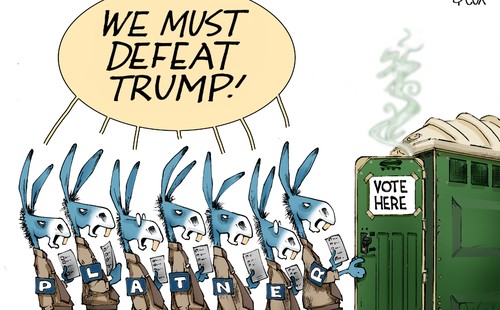
 Senate Democratic leaders Tom Daschle and Harry Reid have shown great skill in creating a sense of fellow feeling in their caucuses and rallying all Democrats to vote for filibusters of nominee targeted by leftist groups like People for the American Way and the Alliance for Justice. Now the focus is likely to be on the seven Democrats who signed the May 23 agreement. Five of the seven are from states Bush carried in 2000 and 2004. Elements of calculation as well as conviction may lead them to refuse to take dictation from the leftist outside groups. Meanwhile, four of the seven Republicans are from states carried by Bush.

 But Supreme Court justices are only one area where Bush initiatives have seemed threatened by the need to get a supermajority. Another is Social Security. House Republicans, rattled by the constituents they regularly encounter at senior citizen centers, are reluctant to vote for a bill containing personal retirement accounts until the Senate does. And in the Senate at least 40 Democrats seem determined to oppose any form of personal retirement accounts.

  But Bush may have some leverage here, as he had leverage to get the somewhat helpful 14-senator deal on judges. Polls continue to show that most voters believe Social Security needs fixing and that young voters doubt that benefits will be there for them. Democrats have had a good time this spring opposing all change, just as they enjoyed holding up the left-targeted judge appointees. But they know, from Democratic pollster Stanley Greenberg and from Tom Daschle's defeat in South Dakota in 2004, that obstruction is not the path to power.

 Bush may need to please more than 51 senators to get a Supreme Court justice confirmed, but the leftist groups will have a harder time finding 40 votes to stop one. And he still has the opportunity to maneuver the Social Security issue to a point where he can get the votes he needs to pass reform.

Share:
Vote on It:
Average Vote:
 
About The Author
Michael Barone is a senior writer with U.S. News & World Report and the principal co-author of The Almanac of American Politics, published by National Journal every two years. He is also author of Our Country: The Shaping of America from Roosevelt to Reagan, The New Americans: How the Melting Pot Can Work Again, the just-released Hard America, Soft America: Competition vs. Coddling and the Competition for the Nation's Future.
 
TOWNHALL DAILY: Be the first to receive Michael Barone's column. Sign up today and receive Townhall.com daily lineup delivered each morning to your inbox.
 
©Creators Syndicate
Sign Up to Post Your CommentsSign Up to Post Your Comments
If you are already registered, click here to login. Otherwise, please take a few seconds to register with Townhall.com. Once you sign up, you’ll be able to post your comments immediately, use the action center, get podcasts, and more!
Note: Fields marked with a red asterisk (*) are required.
Salutation:
First Name:
*
Last Name:
*
Email:
*
Nickname:
*
Note: Nick name will be shown when you post comments.
Address 1:
*
Address 2:
City:
*
State:
*
Zip:
*
Phone:
      
Your daily dose of conservative columns, editorial cartoons, talk radio, news, and more!
(Bi-Weekly) We highlight the best opportunities from our partners for surveys, action items and more.