Last week, Senator Hillary Rodham Clinton unveiled one of the first big domestic proposals of the 2008 presidential campaign: a $10 billion plan for federally funded “universal pre-kindergarten.” The proposal likely pleases the national teachers’ unions, eager to capture the massive public money becoming available to serve the under-five set. Just as bad, the plan assumes that government money can improve people’s lives—to a much greater degree than history has shown.
Under Clinton’s program, the federal government would match individual states’ funding for voluntary pre-K for four-year-olds, with a $10 billion annual cap on federal dollars by the end of the first five years. To be eligible for the matching funds, states would have to hire teachers with bachelor’s degrees that include training in early-childhood development, maintain low student-teacher ratios, and use some standard curricula.
The plan resembles the Great Society’s Medicaid program, enacted four decades ago as a federal-state partnership to provide health care for the poor. Just as in Medicaid, individual states would decide how to structure early-childhood programs within those few basic rules, and would be responsible for a big part of the bill. Unlike with Medicaid, states could choose not to participate, but it would be awfully hard for them to refuse. Politically, what governor can oppose more education for cute kids, especially when a state’s governor and legislature know that they’ll get “credit” for every dollar of such voter-pleasing spending, while having to come up with only 50 cents of it themselves?
Even with the matching funds, though, the federal requirements likely will prove expensive for the states. For one thing, mandating low student-teacher ratios means hiring more teachers. And in places like New York, New Jersey, and California, the union-friendly states that would embrace the program early on, the proposal will almost surely create a huge new demand for expensive teachers from the ranks of the politically powerful unions.
To be sure, Clinton’s plan doesn’t require states to hire unionized teachers. The nation’s fledgling charter schools, which are usually non-union, could add pre-kindergarten classes to their existing elementary schools with the federal matching funds. But innovative, independent charter schools are still a tiny fraction of public education. Unless they want to build freestanding schools for four-year-olds, most states will send the vast majority of their pre-K classes to unionized elementary schools, adding hundreds of thousands of highly paid union jobs to state budgets.
And don’t think that the teachers’ unions want to stop at four-year-olds. In New York earlier this month, after heavy lobbying by the local United Federation of Teachers, Governor Eliot Spitzer signed an executive order that will allow 50,000 day-care workers who care for toddlers in their own homes to unionize and negotiate for higher pay and benefits.

It’s a slippery slope from encouraging bachelor’s degrees and federally approved curricula to teach four-year-olds to requiring bachelor’s degrees and federally approved curricula to watch two-year-olds. And Clinton has already started down it: her proposal notes ambitiously that “states [could] serve younger children [with federal money] once they have provided pre-K to all four year olds who need it.”
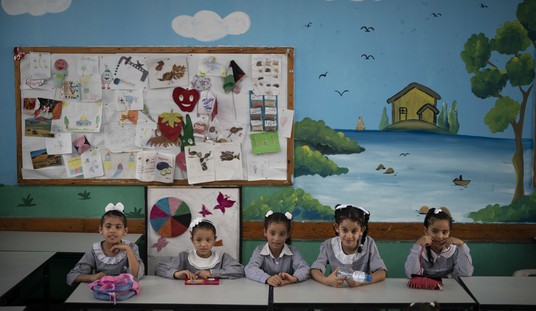
Supporters of universal pre-K and other early-childhood programs often point to the growing evidence that young children develop cognitive skills well before school age. Indeed, study after study has shown that by the time they get to kindergarten, kids from families that don’t provide education at home can’t catch up with peers whose parents, say, read a book to them every day from infancy.
Continued... |