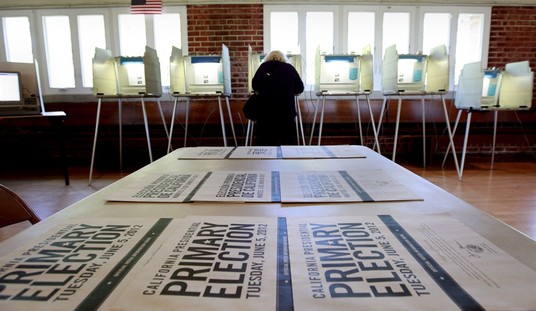
On a quiet spring morning, they're working in Washington. Working hard, as the president would say. Working hard to regulate, burden, and impede your right to communicate about politics. About them.
Congress, with an "atta boy" last go-around from the Supreme Court, is again busily re-writing the rules that determine how the campaigns they run for office ? and the campaigns against them ? will be governed.
In sports, it would be a scandal were one team (let's call them the Incumbents) to write the rules under which they and their opponents (say, the Challengers) played. Why, Congress would be outraged! And compelled to hold show hearings, mugging for the cameras and talking so tough in front of the microphones that you'd think the congressmen were on steroids.
It would be even worse if that same team, after each season, went back to re-rigging those rules.
Yet, that's American politics today . . . now that the First Amendment has been nullified by Congress's Bipartisan Campaign Reform Act, commonly known as McCain-Feingold. President Bush signed the monstrosity, reversing his position while admitting his "constitutional reservations." Reservations the Supreme Court ignored when it upheld the Act. Now, the constitutional guarantee of free speech has been relegated to a relic for tourists to filter past at the National Archives a few blocks away.
Hyperbole? The First Amendment reads, "Congress shall make no law . . . abridging the freedom of speech, or of the press. . . ." Today, incumbents in Congress decide by law how much individuals may give to candidates. And how much Political Action Committees may give. And how much you may give to a PAC. And whether non-profit groups may mention a candidate's name or even show the bum's likeness anywhere close to an election. (They may not.)
Further, Congress takes upon itself supposedly "tricky" issues like whether blogs should be regulated. Or churches.
Of course, money and speech ? like water ? are known to find their way. Thus, the congressional assaults on political speech can never cease, and Congress never rest. Which is why the high court actually encouraged Congress not to stop with McCain-Feingold, but to continually tinker with the election laws to drive out any "outside" or "unregulated" new money and speech that makes it through the current maze. That is the hard legislative work engaging the Senate as America enjoys another spring.
Last election, millionaires and billionaires were able to help a number of groups, known as 527s, raise issues and state their opinions. These rich folk, by making massive contributions, allowed organizations to purchase costly TV time. The meat of the new legislation is to prevent this speech from breaking out again. If the current bill passes, donations to 527s would be limited to $32,500 ? not unlimited as in this past election. Gifts of $32,500 would thus be deemed pristine and patriotic, while spending one cent more would be corrupt and criminal.
The arbitrary nature of such limits is obvious, but often the impact on the process is not so clear. Silence is the result. Or, at least, less speech. Less speech can go unnoticed.
Look at it in economic terms. When capital cannot form in sufficient quantities to start new enterprises, few people notice the stores that haven't opened, the products that haven't been launched, or the innovations never attempted. But, despite the ignorance of the many, an economy with capital formation so restricted will stagnate.
Like our politics stagnates. Continued... |