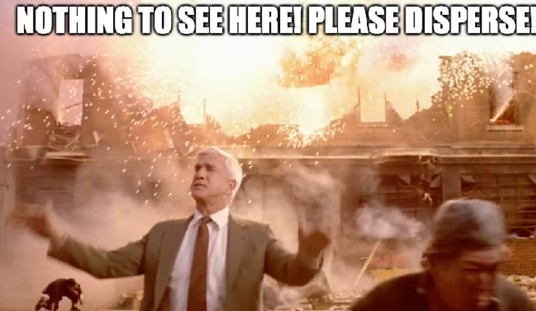
Denial is an often useful innate human trait. Few of us would be able to function in the present if we did not put out of mind many unpleasant realities -- such as our inevitable death. The Woody Allen character in the movie "Annie Hall" stated the comic extreme version of not using the denial mechanism when, as a child he refused to do his homework because in 5 billion years the sun would explode, "so, what's the use?" But when a person, or a society, denies emerging or imminent dangers, the peace of mind it gains will be extremely short term, while the harm may be sustained or fatal. Most of the world today not only is in denial concerning the truly appalling likely consequences of the rise of radical Islam, it often refuses to even accept unambiguous evidence of its existence. The latest minor example of the latter is occurring at University of North Carolina at Chapel Hill. As has been generally reported, an Iranian Muslim student drove a jeep into a crowd of students, causing only minor injuries. He turned himself in and informed the police and the media that he was trying to kill the students to "avenge the deaths of Muslims around the world." Neither the university nor most of the media has been willing to characterize this event as a terrorist attempt by a radical Muslim. Mr. Colmes, on "Hannity and Colmes" seemed to express genuine puzzlement as to why it mattered whether we called it that or merely an act of violence. Similarly, the attack at the Los Angeles International Airport a few years ago was for nine months just called a violent attack, before it was finally characterized by police as a radical Muslim act of terrorism. I have been in contact with British politicians who tell me that there is increasing radical Muslim street violence in Britain that is explicitly motivated by radical Islam but is not reported or characterized as such. Even in its cleansed versions, I am told, these incidents are being extremely underreported. In Antwerp last month, according to the reporter Paul Belien, rioting Moroccan "youths" went on a rampage destroying cars and beating up reporters, but the police were instructed not even to stop them or arrest them. According to an anonymous policeman, "An ambulance was told to switch off its siren because that might provoke the Moroccans." This event, too, was under reported, or not reported at all in American media. And of course, last October in Paris and other French cities, hundreds of buildings were torched and tens of thousands of cars burned by Muslim "youths" through weeks of rioting, while both the French government and most of the "responsible" experts denied there was any radical Muslim component to the greatest urban violence to hit France since World War. It was all to do with poverty and teenage angst and alienation. Of course poverty and alienation can't explain the Iranian student in North Carolina. He has just received one of the finest educations available to a privileged American. He reportedly has received advanced degrees in philosophy and psychology from one of our top universities. The media has pointed out that there is no evidence he was connected to Al Qaeda or another terrorist cell. But that is exactly the point. As I discussed in my book last year, the threat to the West is vastly more than bin Laden and Al Qaeda (although that would be bad enough.) The greater danger is the ferment in Islam that is generating radical ideas in an unknown, but growing percentage of grass-roots Muslims around the world -- very much including in Europe and, to a currently lesser extent, in the United States. Continued... |